26 December 2025 · Prof. George Du Toit
What is 'The Allergic March', aka The Atopic March?
How allergic conditions can progress through childhood — and the two interventions that most reduce the risk.
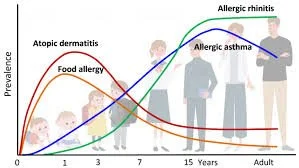
The allergic march, also known as the atopic march, describes the possible progression of allergies in your child. Allergic diseases are usually multi-system in nature, so it is not uncommon for infants with eczema to go on to develop one or more of food allergy, asthma, hayfever, and oral allergy syndrome. While this is true at a population level, it is very hard to predict the likely course for any individual child.
Reducing the risk
While it isn’t possible to alter a genetic predisposition, it does make sense to minimise the risk of progressing along this march by modifying environmental factors. The two most significant disease-modifying interventions are:
- The best possible eczema control, and
- Timely introduction of common and relevant food allergens for your child.
Healthy-living strategies that nurture the gut and skin microbiomes also seem prudent. Pollution and mould are harmful to all lungs, so steps to reduce them — for example air purifiers in bedrooms — seem wise.
Eczema matters most
There are many “eczemas”. Severe eczema — oozing, weeping, crusting, staph-infected, and often on exposed areas such as hands, feet, face, head and neck — is most strongly associated with the development of food allergy. Early and proactive treatment of this is therefore warranted.
It isn’t universal or linear
There is data to support a typical progression — atopic dermatitis and food allergies in infancy, transitioning to wheezing, asthma and allergic rhinitis later — with some conditions, such as eczema, often remitting over time. But the allergic march is not universal or linear. There is significant individual variability, influenced by genetics, environment and immune factors. Not all children follow the typical sequence; some skip stages, and others have persistent or atypical patterns.
Please do contact us if you would like a detailed assessment of your child’s existing allergies and ways in which we may be able to treat and prevent additional allergies from developing.