13 June 2026 · Prof. George Du Toit
Will OIT cure my child's Cashew and Pistachio Allergy?
How oral immunotherapy desensitises children to cashew, and why treating cashew can also cover the closely related pistachio allergy.
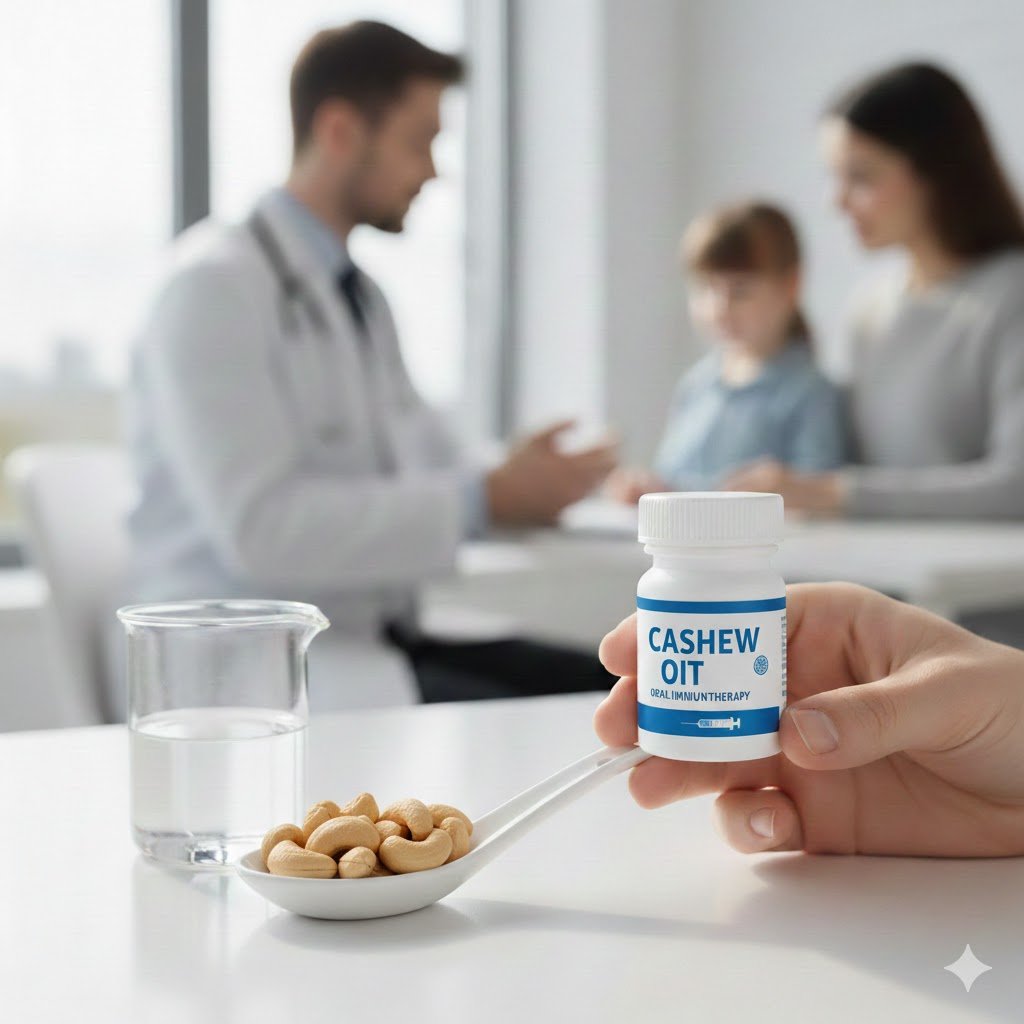
Parents frequently ask whether multiple separate treatment protocols are necessary for related nuts. Cashew and pistachio are closely related, sharing homologous proteins such as Ana o 3 and Pis v 1. This article addresses whether treating one nut can protect against the other, potentially reducing the treatment burden.
What is the best direct evidence for cashew OIT efficacy?
Cashew OIT (desensitisation on therapy): The NUT CRACKER prospective cohort study (Allergy 2022) demonstrated that 44 of 50 (88%) OIT-treated patients tolerated 4000 mg of cashew protein, versus 0 of 15 controls. Only 6% required adrenaline for home reactions. This represents the largest dedicated cashew OIT cohort with an observational control group and standardised oral food challenges.
Pistachio cross-desensitisation after cashew OIT: In the same study, all pistachio co-allergic patients challenged (35 of 35, 100%) were cross-desensitised to pistachio after cashew desensitisation. This directly shows that treating cashew can cover the closely related pistachio allergy. This mirrors our experience in the OIT programme at the Allergy Centre of Excellence, particularly with younger children.
Are there everyday lifestyle restrictions during up-dosing?
- Exercise windows: avoid strenuous activity for 2–3 hours after dosing.
- No empty stomachs: always take daily doses with food or immediately after meals.
- Hot baths and showers: avoid heat soon after dosing, as vasodilation can increase reaction risk.
- Illness adjustments: reduce or withhold doses during viral infections, fevers, tummy upsets, or asthma/hayfever flares. Written adjustment plans are provided.
- Medication co-factors: avoid NSAIDs such as ibuprofen, or seek specialist advice.
Schools and nurseries should be informed about timed dosing, temporary activity restrictions, and access to adrenaline auto-injectors and action plans.
Will cashew/pistachio OIT be a lifelong commitment?
Over time, skin prick tests and blood IgE tests to cashew should decrease, leading to a gentler clinical journey. As levels drop, we discuss less frequent dosing and higher target doses. While some children completely outgrow their allergy on OIT, most do not, so ongoing long-term consumption is typically encouraged, albeit less frequently.
What are the main side effects?
More common side effects during up-dosing include transient oral itching or abdominal cramping. Anaphylaxis can occur with dosing, particularly when co-factors such as illness are present. Longer-term gastrointestinal issues such as Eosinophilic Oesophagitis (EoE) are rare and reversible. All risks are discussed in detail through shared decision-making before commencing any OIT programme.
Where can we access cashew OIT in the UK?
We offer one of the largest OIT services in the UK and Europe. Please do not undertake home-based unsupervised programmes, as anaphylaxis can occur on OIT. OIT should be performed only in highly specialised centres with extensive experience, with immediate access to resuscitation, adrenaline auto-injector training, and clear written plans.